
The virtuous circle of training
Last June, a particularly significant mission was organized by the S.H.A.R.E. association (Sustainable Health in Africa through Responsible Education) at the National Cardiology Center (CNC) in Nouakchott. Since its creation in 2008, the association has seen its work grow and strengthen.
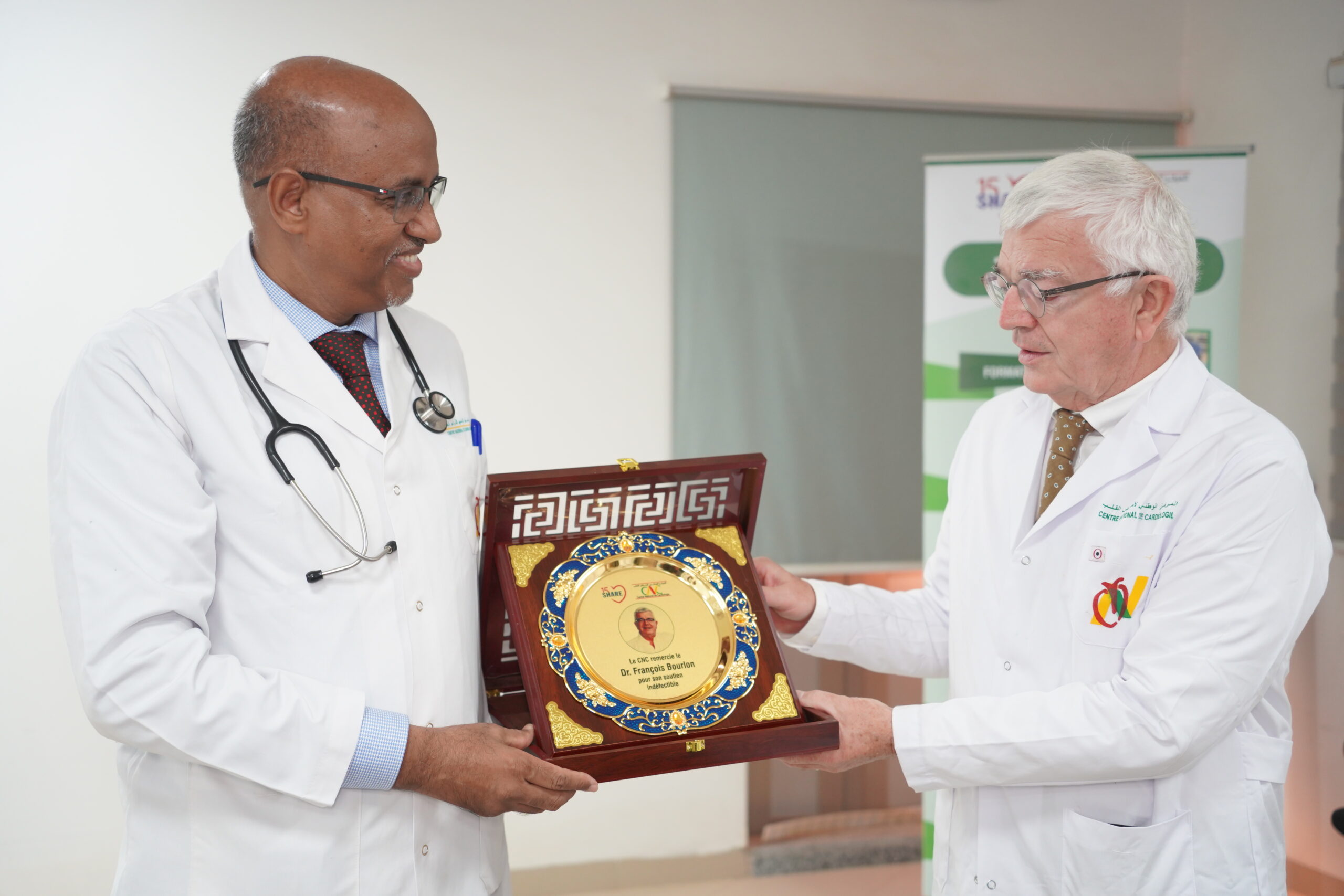
During this mission, alongside Dr François Bourlon, Dr Françoise Le Guillou-Bourlon, and Dr Nicolas Hugues, I had the opportunity to meet once again with the CNC hospital team and was able to observe the continuous progress achieved.
What made this mission particularly remarkable was seeing former trainees become trainers themselves. The professionals who were once learners are now full-fledged experts, continuing to transmit and expand crucial knowledge. The CNC, now equipped with modern and fully functional facilities, operates with remarkable autonomy — a testament to the success of the skills transfer supported by S.H.A.R.E.
S.H.A.R.E.’s initiatives go beyond medical care: they help create networks of knowledge and solidarity that have a lasting impact.
1 MISSION
- Heart of action
Let us recall that, for 15 years, the association has worked to educate physicians, surgeons, nurses, and technicians in order to make the National Cardiology Center (CNC) autonomous.
It has become clear that this goal has been achieved, as medical and surgical activity is now fully autonomous at 90% — what remains is to continue developing congenital cardiology, both for children and for adults and fetuses.
- Objectives and achievements
During the stay, Dr Nicolas Hugues was able to begin antenatal cardiology consultations with his colleagues and take part in consultations for children and infants with heart disease, some of which were severe and/or complex.
At the interventional level, we were able to observe the complete autonomy of the physicians and cardiologists working in the two fully equipped catheterization laboratories. It is worth highlighting the catheter-based treatment of a 4.5 kg infant suffering from a persistent ductus arteriosus causing heart failure: the placement of a percutaneous device successfully cured the child. The procedure was performed by Dr Beichar, an adult and pediatric interventional cardiologist, and a beneficiary of our programs.
A three-year action plan has been developed with the following objectives:
- Development of pediatric medical and surgical cardiology with the training of a pediatric cardiac surgeon, a pediatric intensivist, a pediatric extracorporeal circulation technician, and a pediatric interventional cardiologist.
- Training of a senior nurse in nursing care and service management; this senior nurse will then become the local reference for the on-site training of future health supervisors.